Scaling & high availability
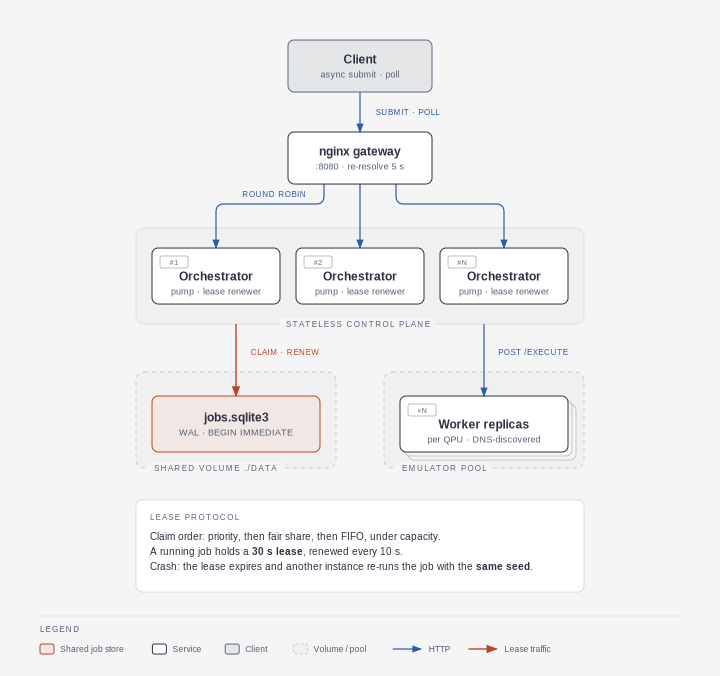
Worker replicas
With QPUTWIN_DISCOVERY=dns (set by Compose), the orchestrator resolves each worker service name to all of its containers every 10 s:
- Jobs go to the replica with the fewest in-flight requests, round-robin among ties.
- A replica that refuses the connection is skipped and the job fails over to the next one. A timeout is never retried, because the worker may already be executing the job.
- The asynchronous dispatch capacity grows with the replica count.
GET /v1/backendslists each replica's status, in-flight and dispatched counts, and failures; telemetry records which replica served each job.
Orchestrator replicas
QPUTWIN_ORCHESTRATOR_REPLICAS=3 QPUTWIN_ORCHESTRATOR_PORTS=8000-8002 \
  docker compose --profile ha up -d --wait          # gateway on :8080
- All replicas share
./data/jobs.sqlite3. Claims are atomic and enforce the global per-backend capacity, so N orchestrators never overload a worker. - The nginx gateway re-resolves
orchestratorthrough Docker DNS every 5 s, and moves on to another replica when a connection fails. - Each orchestrator keeps its own
/v1/telemetryring buffer. The JSONL dataset is shared and complete.
Failure behaviour
| Event | What happens |
|---|---|
| Worker replica stops | its connections are refused; jobs fail over to other replicas |
| Orchestrator stops gracefully | its running async jobs are released to the queue immediately |
| Orchestrator crashes | after the lease (30 s), another instance re-runs the job with the same seed; attempt = 2 |
Same job lost QPUTWIN_JOB_MAX_ATTEMPTS times |
FAILED with an "abandoned" error |
| Store unavailable | /ready returns 503; the gateway and load balancers stop routing to that instance |
Both drills were run against the live stack with two orchestrators behind the gateway:
- Graceful stop: six queued and running jobs all completed on the survivor.
SIGKILLmid-job: the job was re-run by the other instance (attempt 2) with identical counts.
Throughput expectations
From the scaling benchmark on the 16-vCPU server (median of five runs):
| Workload | 1 replica | 2 replicas | 3 replicas |
|---|---|---|---|
| 14 qubits (256 KiB state) | 85.9 jobs/s | 85.3 jobs/s | 121.4 jobs/s |
| 20 qubits (16 MiB state) | 15.7 jobs/s | 32.6 jobs/s | 48.5 jobs/s |
- Small jobs (≈ 4 ms of worker time) are limited by the orchestrator's asynchronous dispatch to one backend, at roughly 85–120 jobs/s (median of five runs; single runs range 46–184), so extra workers help little (1.41× with three). Add orchestrator replicas instead.
- Large statevectors scale linearly on one host: 3.10× with three replicas (20 qubits), with no growth in per-job time. The fused engine reads and writes the state once per gate block rather than several times per gate, so replicas share memory bandwidth well. Beyond the host's cores, scale across hosts.
From the load tests, synchronous light jobs (GHZ₈, 256 shots):
| Setup | Peak throughput |
|---|---|
| one worker | 289 jobs/s |
| seven QPUs, one orchestrator | 374–378 jobs/s |
| seven QPUs, three orchestrators behind the gateway | 917 jobs/s |
| heavy QV-style 12-qubit jobs, 1 → 4 Forte replicas | 10.2 → 25.2 jobs/s |
- Add orchestrator replicas (
QPUTWIN_ORCHESTRATOR_REPLICAS, profileha) once fast jobs exceed about 300 jobs/s; the gateway also keeps an overloaded orchestrator stable. - Keep the concurrency per worker near the knee of its throughput curve (8–16 clients for millisecond jobs), or use the asynchronous queue, which never sends a worker more than its capacity.
Limits
The SQLite store coordinates instances on one host. Spreading orchestrators across hosts requires a networked store implementing the JobStore interface (qputwin_orchestrator/jobs.py).