QPUTwin: Calibration-Faithful Digital Twins of Trapped-Ion and Superconducting Quantum Processors
QPUTwin is an open-source quantum digital twin and QPU emulator. It reproduces seven real quantum processors (Quantinuum Helios, IonQ Forte, Rigetti Ankaa-3, IQM Emerald, IBM Heron r3, IBM Nighthawk and Google Willow), with their native gates, qubit connectivity, calibrated noise and gate timing, behind one OpenQASM API.
Get started Quick start Benchmark results
Koustav Kumar Mondal · koustav@koustavmondal.com
What you can do with QPUTwin
Run on seven QPUs side by side
Submit one OpenQASM circuit and run it on all-to-all trapped-ion and square-lattice superconducting twins, with identical semantics. Devices →
Calibration-faithful noise
Every gate reproduces its published fidelity exactly, together with T1/T2, crosstalk, leakage, quasi-static drift and readout error. Noise →
Enforce or route topology
Topology violations are rejected exactly as a vendor compiler would reject them, or routed with SABRE so the cost can be measured. Routing →
Exact latency telemetry
Every response decomposes its round trip into additive spans, which is ready-made data for quantum-cloud benchmarking papers. Telemetry →
Hardware time estimates
An ASAP schedule from calibrated gate durations estimates the wall-clock time per shot and per job on the real device. Timing →
Production deployment
Asynchronous jobs on a durable shared queue, worker replicas, API keys, Prometheus metrics and an HA gateway. Operations →
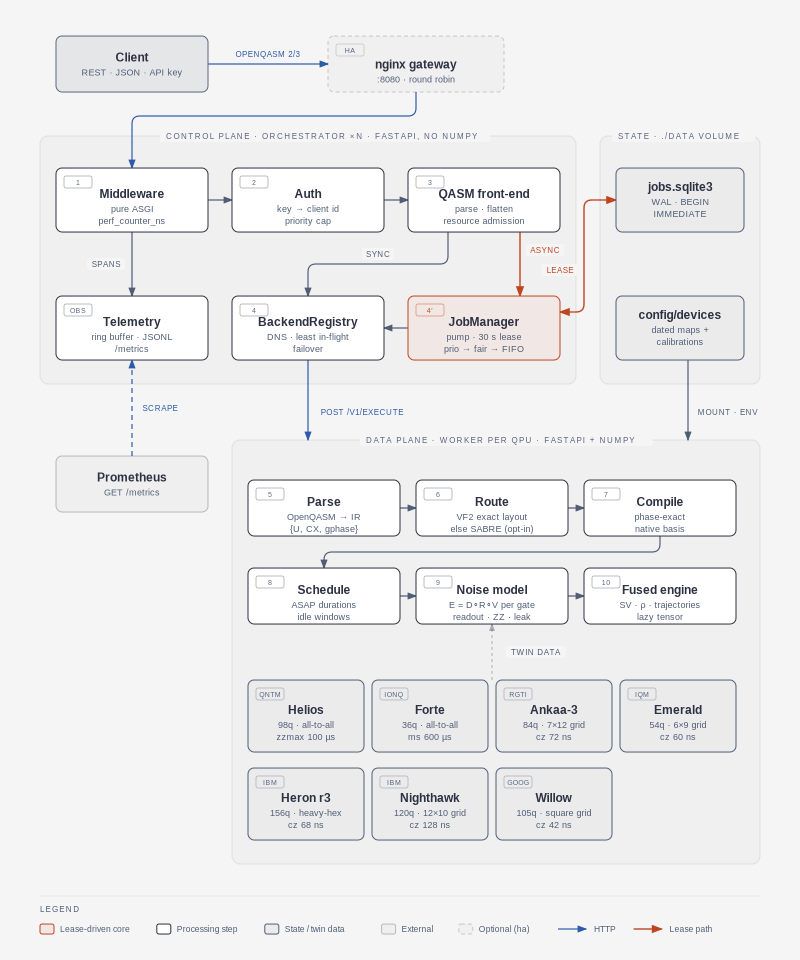
Architecture at a glance
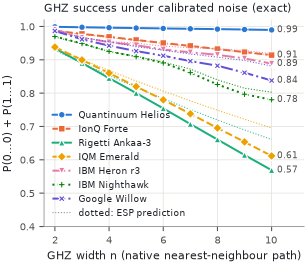
Results at a glance
A first job
git clone https://github.com/Cloudslab/QPUTwin.git qputwin && cd qputwin
docker compose up -d --build
curl -s localhost:8000/v1/jobs -H 'content-type: application/json' -d '{
  "backend": "iqm_emerald",
  "qasm": "OPENQASM 2.0;\ninclude \"qelib1.inc\";\nqreg q[2];\ncreg c[2];\nh q[0];\ncx q[0],q[1];\nmeasure q -> c;",
  "shots": 1000, "seed": 7,
  "options": {"noise": {"model": "device"}}
}'
The response carries the counts, the compilation report (native gates, depth, hardware time estimate), the noise report (which calibration values were used and where they come from), and the telemetry decomposition. See Quick start.
Research honesty
Every calibration number is tagged published (with its source) or assumed, and every noisy result lists the values it relied on. A strict mode refuses to run on unpublished values. See Calibration data.