Gate-duration model
Every compiled job carries compilation.hardware_time_estimate, computed by an ASAP list schedule over the native circuit (qputwin_core.scheduling).
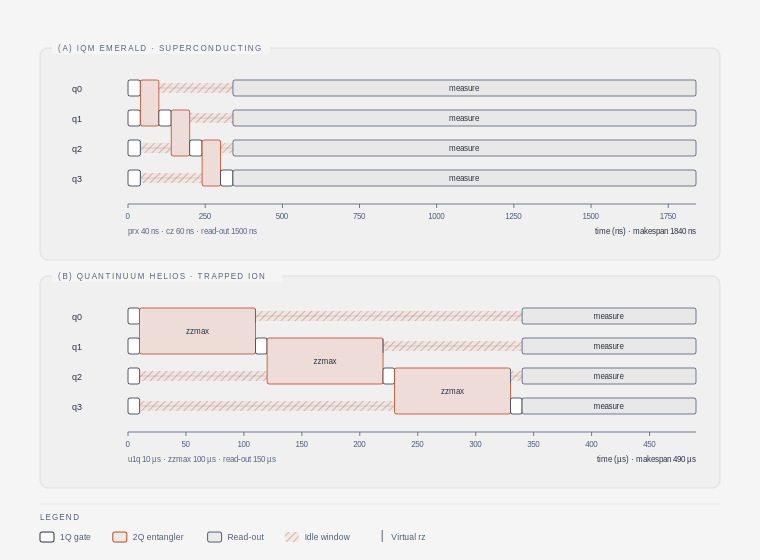
The figure is computed by the scheduler itself at build time. The same GHZ circuit takes 1.84 µs per shot on IQM Emerald, most of it the 1.5 µs read-out, and 490 µs on Quantinuum Helios, where each zzmax lasts 100 µs. The hatched spans are the idle windows in which the noise model applies relaxation.
Scheduling rules
- Durations come from the calibration, using per-coupler and per-qubit values first. Virtual gates take 0, measurements the readout time, resets the reset time.
- An operation starts when all of its qubits are free.
- Barriers synchronise their qubits.
- A classically controlled operation waits for the measurement that wrote its condition bits, plus
feedforward_latency_nswhen known. The timeline is fixed: the slot is reserved whether or not the operation fires. - Final measurements are aligned to start together after the last gate, as on hardware that reads every qubit out at the end. Early-finishing qubits idle, and relax in the noise model.
- Parallelism limits (
parallelism.max_parallel_one_qubit/max_parallel_two_qubit) delay an operation until a slot of its kind is free. For IonQ Forte, QPUTwin assumes one entangling gate at a time on the shared motional bus; this is a modelling assumption, because IonQ does not publish its gate parallelism. - QCCD transport and cooling (
qccd.transport_ns_per_two_qubit_gate,cooling_ns_per_two_qubit_gate) precede every two-qubit gate. The noise model treats that window as idle time.
The report
The output below is real: a 12-qubit GHZ chain on iqm_emerald, 1000 shots.
"hardware_time_estimate": {
  "model": "asap_list_schedule",
  "final_measurements": "aligned",
  "circuit_duration_us": 2.64,
  "shot_overhead_us": null,
  "estimated_job_duration_s": 0.00264,
  "includes_shot_overhead": false,
  "includes_feedforward_latency": false,
  "includes_qccd_transport": false,
  "parallelism": {"max_parallel_one_qubit": null, "max_parallel_two_qubit": null},
  "conditional_timing": "fixed_timeline",
  "busy_time_us": {"one_qubit": 0.92, "two_qubit": 0.66, "measure": 18.0, "reset": 0.0, "transport": 0.0},
  "conditional_ops_scheduled_as_executed": 0,
  "missing_durations": [],
  "complete": true,
  "calibration": "IQM Emerald - nominal medians",
  "assumed_parameters": ["gates.cz.duration_ns", "gates.prx.duration_ns", "readout.duration_ns"]
}
circuit_duration_usis the makespan of one shot.estimated_job_duration_sisshots × (makespan + shot_overhead).busy_time_ussums operation durations, not wall time.- The flags state exactly what is excluded. Feed-forward latency is published by no vendor. Per-shot overhead (cooling, state preparation, repetition delay) is published only as IBM's repetition delay, which the IBM twins include; elsewhere it is excluded unless a calibration supplies it.
Most packaged durations are placeholders
assumed_parameters lists the durations that are not vendor-published. Load a dated snapshot (Calibration data) before quoting absolute times. The relative picture is robust: superconducting shots take microseconds, trapped-ion shots milliseconds (see the benchmark).