Emulated devices
| Backend ID | Device | Technology | Qubits | Connectivity | Native 1Q | Native 2Q | CX realised with |
|---|---|---|---|---|---|---|---|
quantinuum_helios |
Quantinuum Helios | Trapped ion (¹³⁷Ba⁺, QCCD) | 98 | all-to-all \(K_{98}\) | u1q(θ,φ), virtual rz |
zzmax, rzz(θ) |
1 × ZZMax |
ionq_forte |
IonQ Forte | Trapped ion (¹⁷¹Yb⁺) | 36 | all-to-all \(K_{36}\) | gpi(φ), gpi2(φ), virtual rz |
ms(φ₀,φ₁,θ), zz(θ) |
1 × MS |
rigetti_ankaa_3 |
Rigetti Ankaa-3 | Superconducting transmons | 84 | 7 × 12 square lattice | rx(kπ/2), virtual rz |
cz, iswap |
1 × CZ |
iqm_emerald |
IQM Emerald | Superconducting transmons | 54 | 6 × 9 square lattice | prx(θ,φ), virtual rz |
cz |
1 × CZ |
ibm_heron |
IBM Heron r3 (ibm_boston) |
Superconducting transmons | 156 | heavy-hex, 175 of 176 couplers | sx, x, virtual rz |
cz |
1 × CZ |
ibm_nighthawk |
IBM Nighthawk r1 (ibm_miami) |
Superconducting transmons | 120 | 12 × 10 square lattice, 211 of 218 couplers | sx, x, virtual rz |
cz |
1 × CZ |
google_willow |
Google Willow (willow_pink) |
Superconducting transmons | 105 | square grid, 182 couplers | phased_xz(θ,φ,ζ), virtual rz |
cz |
1 × CZ |
Gate definitions
| Gate | Matrix / definition |
|---|---|
U(θ,φ,λ) |
OpenQASM 2 definition \(\begin{pmatrix}\cos\frac\theta2 & -e^{i\lambda}\sin\frac\theta2\\ e^{i\phi}\sin\frac\theta2 & e^{i(\phi+\lambda)}\cos\frac\theta2\end{pmatrix}\) |
u1q(θ,φ), prx(θ,φ) |
\(R(\theta,\phi) = e^{-i\frac\theta2(\cos\phi X + \sin\phi Y)}\) |
sx, x |
\(\sqrt{X} = e^{i\pi/4}R_X(\pi/2)\) and \(X = e^{i\pi/2}R_X(\pi)\); IBM synthesises any one-qubit gate as rz · sx · rz · sx · rz |
phased_xz(θ,φ,ζ) |
\(R_Z(\zeta)\,R(\theta,\phi)\): Google's cirq.PhasedXZGate(x_exponent=θ/π, axis_phase_exponent=φ/π, z_exponent=ζ/π), in radians, one 25 ns microwave pulse |
gpi(φ) |
\(\begin{pmatrix}0 & e^{-i\phi}\\ e^{i\phi} & 0\end{pmatrix}\) |
gpi2(φ) |
\(R(\pi/2,\phi)\) |
ms(φ₀,φ₁,θ) |
\(e^{-i\frac\theta2\,\sigma_{\phi_0}\otimes\sigma_{\phi_1}}\), θ in radians (IonQ's API uses turns) |
rzz(θ), zz(θ) |
\(e^{-i\frac\theta2 Z\otimes Z}\); zzmax = rzz(π/2) |
cz, iswap |
standard |
Every closed form is checked against scipy.linalg.expm of its generator in the test suite.
Connectivity
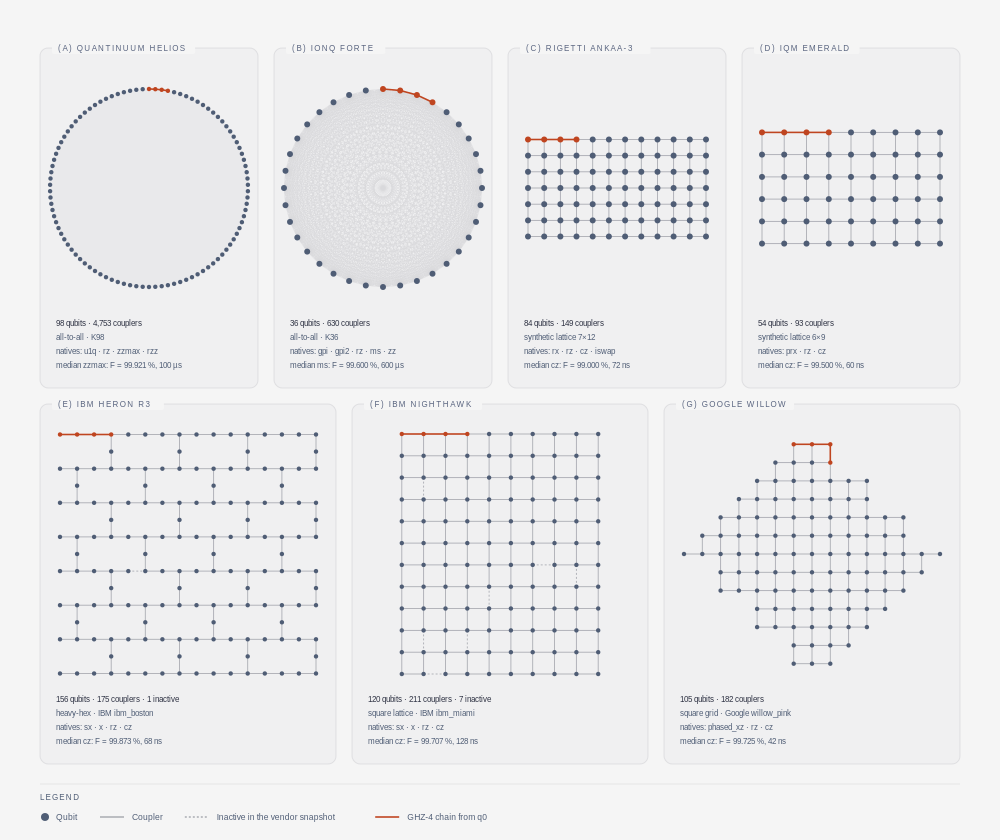
The figure shows all seven twins. The IBM and Google maps also carry each qubit's position in coupling_map.layout (coordinates for Heron and Willow, rows × cols for Nighthawk); notebook 01 draws them.
- Trapped ion. Any pair of distinct qubits may interact; the complete graph is stored implicitly.
- Superconducting. A symmetric boolean adjacency matrix
Ais held as a numpy array. Every pair of qubits touched by every multi-qubit operation, after library expansion, must satisfyA[p, q] = 1. Accxtherefore cannot run on a square lattice, because the lattice has no triangles.
On a row-major lattice (Ankaa-3, Emerald, Nighthawk), qubit (r, c) has index r·cols + c. On Willow, index i is the i-th GridQubit in (row, column) order, and on Heron the rows of 16 qubits are joined by bridge qubits, as in IBM's numbering. Inspect any coupling map with:
curl -s localhost:8000/v1/backends/rigetti_ankaa_3 | python3 -c \
  'import json,sys; d=json.load(sys.stdin); print(d["coupling_map"]["n_edges"], d["coupling_map"]["degree"])'
Methods note: which coupling maps are synthetic
The Rigetti and IQM maps are synthetic nearest-neighbour lattices that match each device's published qubit count and connectivity class. They are not vendor calibration snapshots, which would contain defective qubits and couplers. Load a real map at runtime, with no code change; see Calibration data.
The IBM Heron, IBM Nighthawk and Google Willow maps are the vendors' published maps. IBM's couplers reported as not working in the snapshot (cz error = 1) are removed and listed in layout.inactive_couplers.
Calibration at a glance
| Device | Published values used | Assumed placeholders |
|---|---|---|
| Quantinuum Helios | 1Q 99.9975 %, 2Q 99.921 % (Quantinuum launch blog); SPAM 99.967 % (Sandia/Quantinuum benchmark) | all durations; QCCD transport and gate-zone parallelism not modelled; T1/T2 not modelled (hyperfine coherence far exceeds circuit times) |
| IonQ Forte | 1Q 99.98 %, 2Q 99.6 %, SPAM 99.5 % (IonQ Forte system page) | gate times (IonQ Aria figures 135 µs / 600 µs), readout/reset times, T1 = 10 s and T2 = 1 s (Aria), one entangling gate at a time |
| Rigetti Ankaa-3 | median iSWAP 99.0 % at 72 ns (Ankaa-3 launch) | CZ = iSWAP fidelity; 1Q fidelity and duration; readout; T1 = 30 µs, T2 = 20 µs |
| IQM Emerald | median CZ 99.5 %, 1Q 99.93 % (IQM / Amazon Braket launch); T1 = 54.7 µs, T2 = 16.6 µs (arXiv:2608.30176) | durations; readout fidelity (IQM Radiance typical value) |
| IBM Heron r3 | IBM's ibm_boston calibration snapshot (2026-04-17), per qubit and per coupler: T1, T2, readout p01/p10 and length, sx/x error and length, cz error and length; median CZ error 1.27 × 10⁻³ (45 couplers below 10⁻³), 68 ns; rep delay 250 µs |
T2 clipped to 2·T1 on 3 qubits |
| IBM Nighthawk | IBM's ibm_miami calibration snapshot (2026-04-17), same fields; median CZ error 2.93 × 10⁻³, median T1 330 µs; rep delay 4 ms |
reset duration (no reset in the snapshot; a readout length is used); T2 clipped on 1 qubit |
| Google Willow | Google's willow_pink device specification and calibration snapshot (2024-08-16), per qubit and per coupler: idle T1, readout p00/p11 errors, RB and CZ XEB Pauli errors (converted to average error); PhasedXZ 25 ns, CZ 42 ns, readout 600 ns, reset 160 ns |
T2, derived from the RB incoherent error with Cirq's formula (Google publishes none); the CZ error is the per-cycle XEB error, so it includes a single-qubit layer |
GET /v1/backends/{id} returns the complete calibration, including a provenance tag for every field.
The IBM and Google twins
IBM and Google publish real calibration snapshots of their processors inside their SDKs: qiskit-ibm-runtime holds IBM backend properties and coupling maps, and cirq-google holds Willow's device specification and a median calibration. scripts/import_vendor_snapshots.py converts them, offline, into QPUTwin's packaged files; QPUTwin itself still uses no vendor SDK at run time. Run it again to refresh the snapshot, or to import another system of the same family:
uv run --no-project --with qiskit-ibm-runtime==0.51.0 --with cirq-google==1.7.0 \
    python scripts/import_vendor_snapshots.py --heron fake_pittsburgh -o config/devices
The twins were checked against the vendors' own tools (simulator comparison):
- every native operation the twins emit after SABRE routing is supported by IBM's
Targetforibm_bostonandibm_miami, and every routed Willow circuit passescirq_google'swillow_pinkdevice.validate_circuit; the coupling maps equal the vendors' maps, minus IBM's inactive couplers; - compiled circuits equal their sources to about 10⁻¹⁵, computed with Qiskit's
Operatorandcirq.unitary; - on 33 circuits per twin, run unchanged on the same physical qubits, the twins reproduce the vendors' own noise models of the same snapshots to a median Hellinger-fidelity difference of 0.0014 (Heron, Qiskit Aer
from_backend), 0.0011 (Nighthawk) and 0.0014 (Willow, Cirq), at most 0.026. A twin built from the same snapshots' device medians differs by up to 0.06–0.16, because medians cannot see which qubits are poor. - Cirq's model of Willow also decays qubits for the 600 ns of every measurement, on top of a measured readout error that already contains that decay; QPUTwin does not count it twice, so Cirq as shipped predicts 0.027 lower fidelity on average.
These are checks against the vendors' published models, not against hardware.