Asynchronous jobs
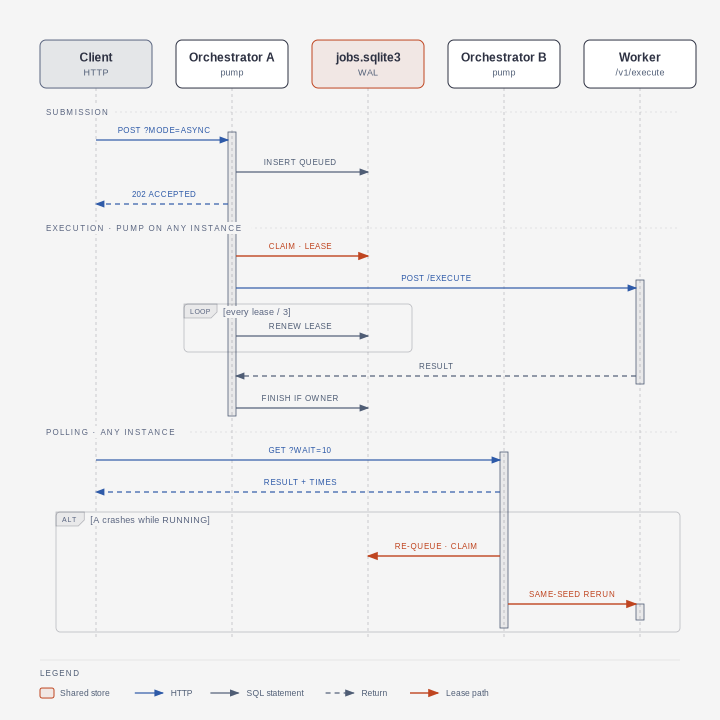
Use asynchronous execution for long jobs (wide or noisy circuits), batch submissions, or when your client cannot hold an HTTP connection open.
Life cycle
Submit
curl -si 'localhost:8000/v1/jobs?mode=async' -H 'content-type: application/json' -d @job.json
# or: -H 'Prefer: respond-async'
HTTP/1.1 202 Accepted
Location: /v1/jobs/9b2e…
Retry-After: 1

{"job_id": "9b2e…", "backend": "ionq_forte", "status": "QUEUED", "execution_mode": "async",
 "client": "anonymous", "priority": 5, "submitted_at": "2026-10-24T15:40:12.531Z",
 "queue_position": 1, "links": {"self": "/v1/jobs/9b2e…"}}
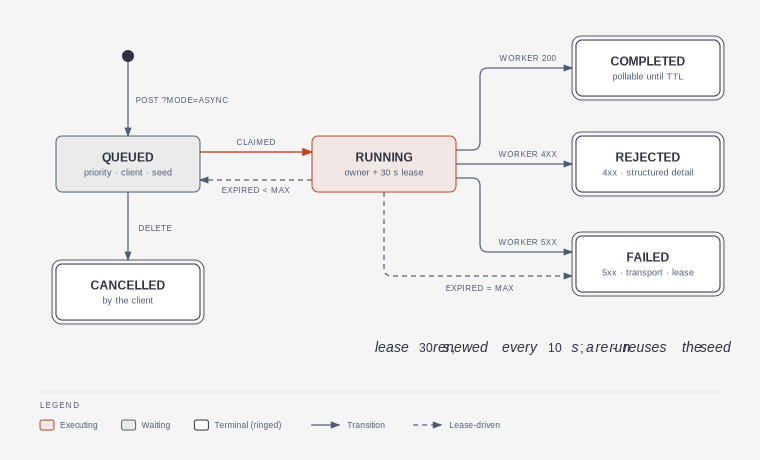
Validation is synchronous. Malformed OpenQASM, unknown backends and resource violations are rejected immediately with the normal error envelope, and only valid jobs are queued. A full queue returns 503 QueueFullError.
Poll and long-poll
curl -s "localhost:8000/v1/jobs/$JOB"            # immediate status
curl -s "localhost:8000/v1/jobs/$JOB?wait=10"    # wait up to 10 s (capped by QPUTWIN_MAX_POLL_WAIT_S = 30)
While the job is QUEUED or RUNNING you get the summary (including queue_position) and a Retry-After header. Once it finishes, you get exactly the body a synchronous call would have returned, plus submitted_at, started_at, finished_at, http_status, attempts, client and priority.
import httpx, time

c = httpx.Client(base_url="http://localhost:8000", timeout=60)
job = c.post("/v1/jobs", params={"mode": "async"}, json=payload).json()
while True:
    body = c.get(f"/v1/jobs/{job['job_id']}", params={"wait": 20}).json()
    if body["status"] not in ("QUEUED", "RUNNING"):
        break
print(body["status"], body.get("result", {}).get("counts"))
Cancel and list
curl -s -X DELETE "localhost:8000/v1/jobs/$JOB"      # only QUEUED jobs; RUNNING → 409 JobStateError
curl -s "localhost:8000/v1/jobs?status=QUEUED&backend=ionq_forte&limit=50"
GET /v1/jobs also returns queues: the queued, running and capacity counts per backend, across all orchestrator instances.
Scheduling: capacity, priority, fair share
Each backend has a dispatch capacity of replicas × QPUTWIN_ASYNC_PER_REPLICA_CONCURRENCY (default 1 slot per worker replica), enforced globally across orchestrator instances. When a slot frees up, the next job is chosen by:
- priority: the request's
priorityfield (0–9, 9 first), capped by the API key's maximum; - fair share: the client with the fewest running jobs on that backend goes first; on a tie, the client served least recently there. With one dispatch slot this is round-robin between active clients, so a client that queues hundreds of jobs cannot delay another client by more than about one job per turn (measured);
- FIFO: submission order.
The client identity is the API-key name when authentication is on, otherwise the X-QPUTwin-Client header (default anonymous). With API keys, every client sees only its own jobs.
Durability, leases and recovery
With QPUTWIN_JOB_STORE=sqlite (the Compose default), jobs live in ./data/jobs.sqlite3:
- Jobs survive orchestrator restarts.
- Several orchestrator instances share one queue; every transition is a single
BEGIN IMMEDIATEtransaction. - A running job holds a lease (
QPUTWIN_JOB_LEASE_S, default 30 s), renewed every lease/3. - Graceful stop: the lease is released immediately.
- Crash: the lease expires and another instance re-runs the job, up to
QPUTWIN_JOB_MAX_ATTEMPTS(default 3) executions; then the job isFAILEDas abandoned. - Delivery is at-least-once. Re-execution is idempotent: the seed is fixed at submission, so a retry returns identical counts. A stale owner's late result is discarded.
Retention
Finished jobs stay pollable for QPUTWIN_ASYNC_TTL_S (default 3600 s), up to QPUTWIN_ASYNC_RETENTION jobs; after that, GET returns 404 JobNotFoundError. Every job is also recorded once in the telemetry dataset when it finishes.
Telemetry for asynchronous jobs
The same additive identities hold. orchestrator_queue_ms measures the wait in the queue.
queue_clock: "perf_counter": the accepting instance also executed the job, so every span uses the same monotonic clock.queue_clock: "realtime": another instance (or a restarted one) executed it. The pre-dispatch spans come from the store, and the queue time uses the host's realtime clock, which containers on one host share.attemptcounts executions.