Architecture
Components
Orchestrator (qputwin_orchestrator)
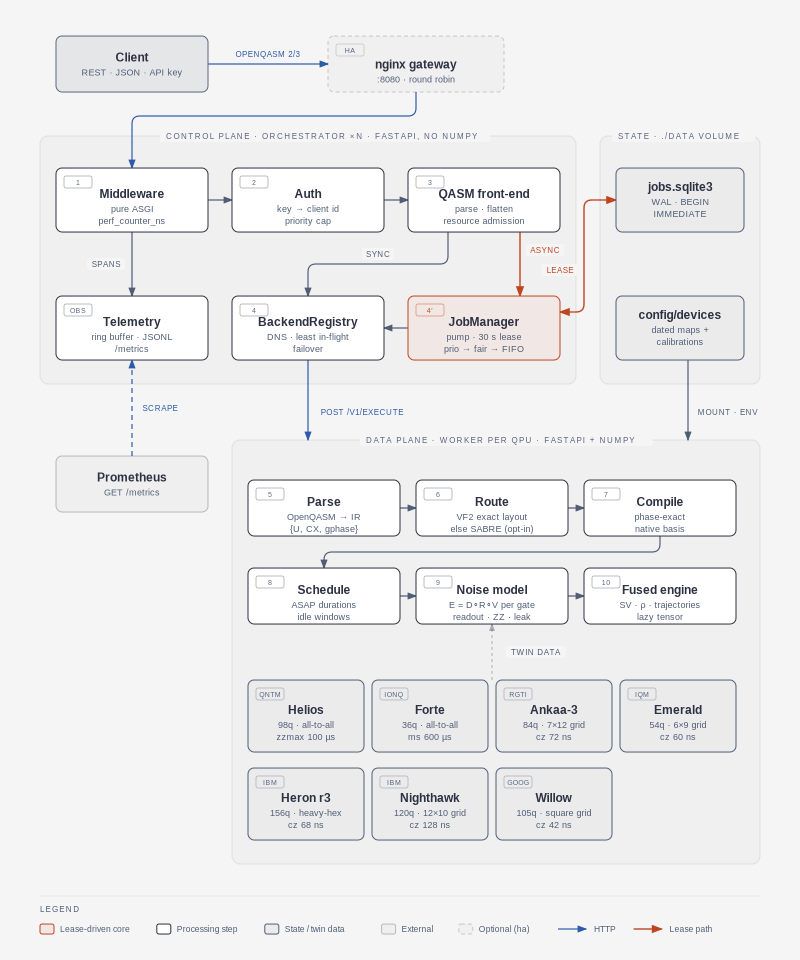
It is the only service that publishes a host port (8000), and it ships without numpy: its OpenQASM front-end is pure Python.
| Module | Responsibility |
|---|---|
middleware.py |
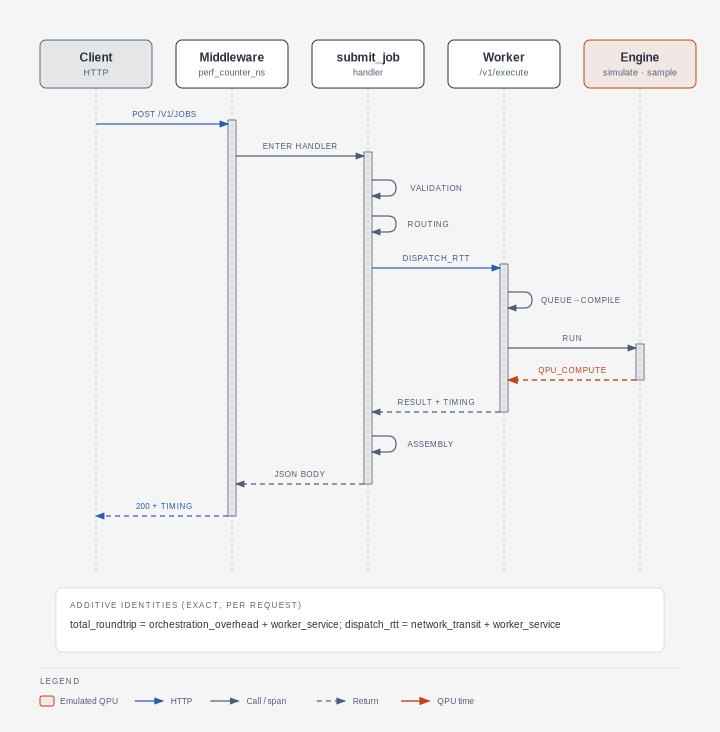
Pure-ASGI BenchmarkingMiddleware: stamps t0 with perf_counter_ns, adds Server-Timing and X-QPUTwin-Job-Id, and records each job in the dataset |
app.py |
Routes, authentication, validation (parse, flatten, size and shot limits), dispatch, error envelope |
registry.py |
Backends → worker replicas; DNS discovery; least-in-flight balancing; connect-failover |
jobs.py |
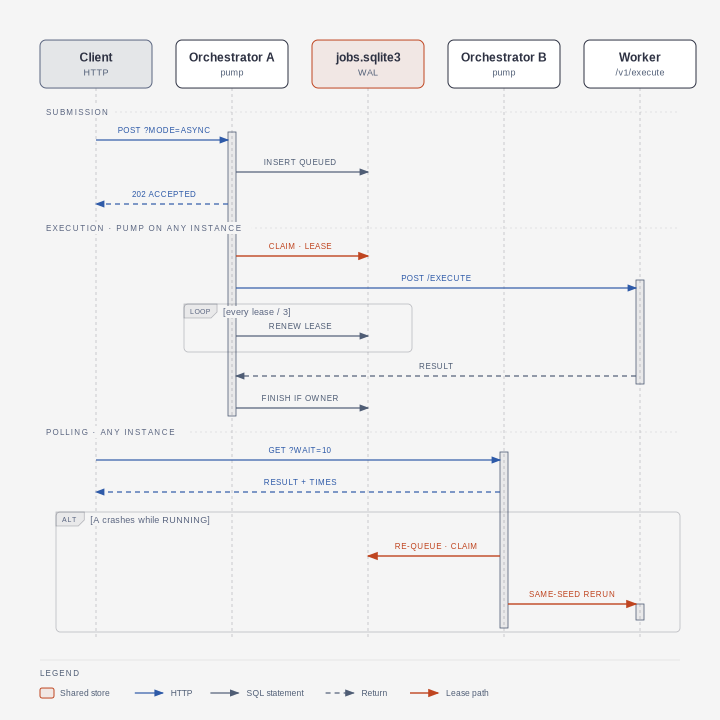
Asynchronous job manager and stores (memory, sqlite): leases, priority, fair share |
telemetry.py |
Additive span recorder, ring buffer, JSONL dataset sink |
metrics.py |
Prometheus exposition fed by the telemetry stream |
The orchestrator parses but does not check topology. Topology and native-gate checks belong to the emulator, as on real clouds, where the vendor-side compiler rejects the job. This split also lets validation latency and emulator rejection latency be measured separately.
Workers (qputwin_worker)
There is one image for all seven worker services; QPUTWIN_VENDOR selects the device module. Each worker:
- applies runtime overrides (
QPUTWIN_COUPLING_MAP,QPUTWIN_CALIBRATION) to itsDeviceSpec; - runs jobs one at a time by default (
QPUTWIN_WORKER_CONCURRENCY=1), which models a QPU's serial queue; - reports durations only (never timestamps), so clock skew between containers cannot enter the measurement.
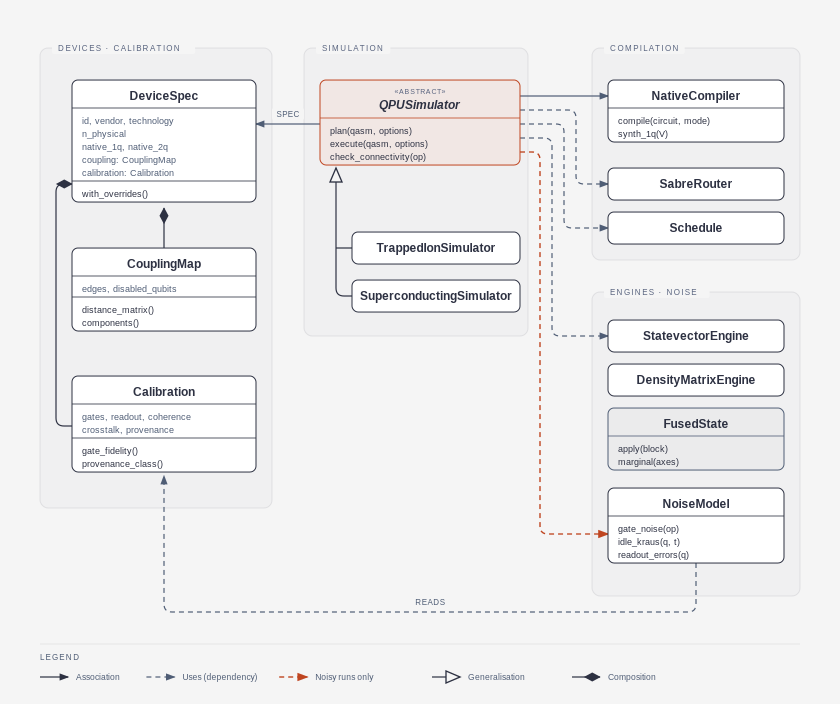
Physics core (qputwin_core)
It is shared by both services and also usable as a library.
Deployment topologies
| Topology | How | When |
|---|---|---|
| Single host, one orchestrator | docker compose up -d |
development, benchmarking |
| Scaled workers | QPUTWIN_<DEVICE>_REPLICAS=3 or --scale worker-…=3 |
throughput |
| HA orchestrators | --profile ha with QPUTWIN_ORCHESTRATOR_REPLICAS=N |
availability |
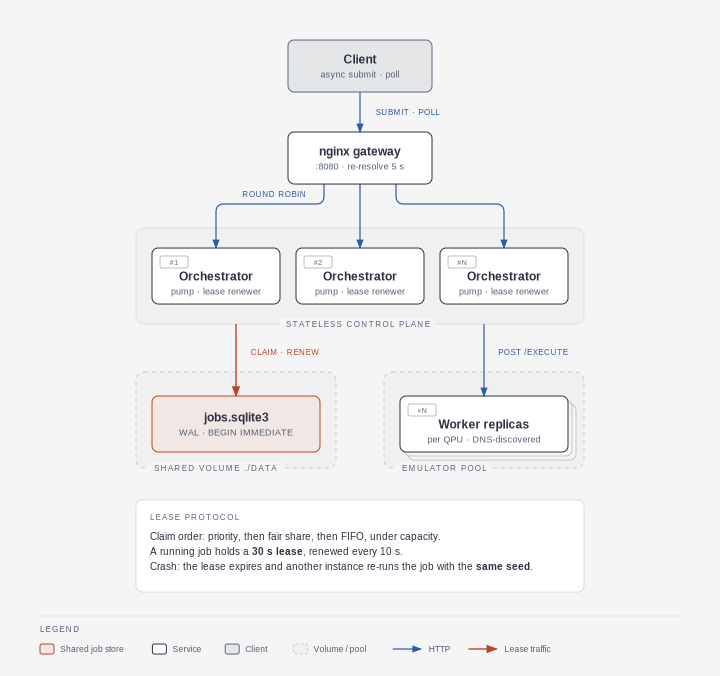
See Scaling & high availability.
Request paths