Calibration data
Each device ships a packaged calibration with nominal medians (src/qputwin_core/devices_data/calibration/<id>.json) and a coupling map (devices_data/*.json). Both can be replaced at runtime, with no code change.
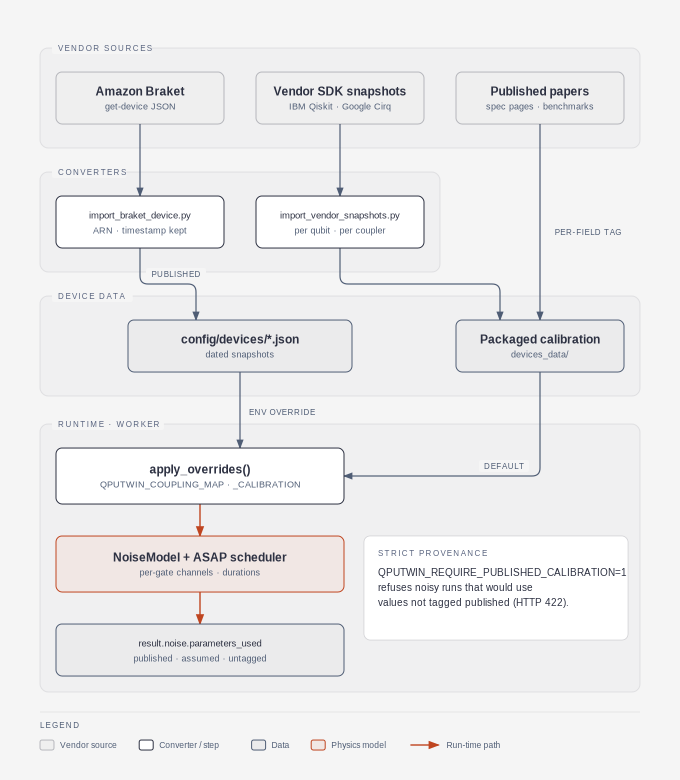
Provenance
Every value carries a tag:
published: <source>: a vendor or peer-reviewed number, with its citation;assumed: <reason>: a placeholder typical of the technology class. Do not quote results that depend on these without replacing them.
Tags are served at GET /v1/backends/{id} under calibration.provenance, and every noisy result lists the paths it used in result.noise.parameters_used. Lookups take the most specific prefix (gates.cz.fidelity before gates), and * tags a whole file.
Load a dated vendor snapshot (Amazon Braket)
aws braket get-device --device-arn arn:aws:braket:eu-north-1::device/qpu/iqm/Emerald > emerald.json
uv run python scripts/import_braket_device.py emerald.json --device iqm_emerald -o config/devices
#   wrote config/devices/iqm_emerald_2026-10-20_calibration.json
#   wrote config/devices/iqm_emerald_2026-10-20_coupling.json: 54 qubits, ... couplers
The importer reads:
- the connectivity graph (vendor labels map to dense indices, recorded in
layout.labels); - per-qubit T1/T2 (a measured T2 > 2·T1 is clipped, and the clip is recorded);
- randomized-benchmarking and readout fidelities;
- per-coupler two-qubit gate fidelities;
- IonQ's fidelity and timing provider properties.
Medians become device defaults. Every imported value is tagged published: Amazon Braket device properties (<ARN>, updated <timestamp>). Values Braket does not publish (gate durations on the superconducting devices) keep the packaged value and its tag, so the gap stays visible.
Note
The importer follows Braket's standardized_gate_model_qpu_device_properties v1/v2 schema and the IonQ provider schema. It is tested on payloads shaped like those schemas; check it on a real export first.
Select the files
Put them in config/devices/, which is mounted read-only at /app/config/devices, and set in .env:
QPUTWIN_EMERALD_COUPLING_MAP=/app/config/devices/iqm_emerald_2026-10-20_coupling.json
QPUTWIN_EMERALD_CALIBRATION=/app/config/devices/iqm_emerald_2026-10-20_calibration.json
docker compose up -d --wait worker-iqm-emerald
curl -s localhost:8000/v1/backends/iqm_emerald?refresh=true | python3 -m json.tool | head -40
environment.worker.coupling_map and environment.worker.calibration in every telemetry record name the files the job ran with.
Other coupling-map formats
uv run python scripts/import_coupling_map.py vendor_map.json --device rigetti_ankaa_3 \
    --provenance "Rigetti Ankaa-3 calibration 2026-10-01" --disabled 5 30 -o config/devices/ankaa3.json
Accepted inputs:
- Qiskit-style pair lists
[[0,1],[1,2],…]; - objects with
edges,coupling_map,couplersorconnectivity(IQMQB<n>labels are sorted naturally); - text edge lists.
Options: --disabled marks defective qubits, --disable-isolated disables qubits with no couplers, and --keep-indices keeps integer labels.
Defective qubits and couplers
A coupling map may list disabled_qubits:
- Such qubits lose every coupler.
- Any operation on them is rejected with
TopologicalCompilationError(details.reason = "disabled_qubit"). - The router avoids them.
- A removed coupler is simply absent from
edges.
Strict provenance
Noisy runs that would use any non-published value fail with 422 CalibrationProvenanceError, and details.unpublished_parameters lists them. Request overrides (options.noise.*) are allowed, because you supply them. Ideal runs are never blocked.
The complete file format is on Calibration file format.