Qubit routing
By default QPUTwin rejects circuits that violate a device's connectivity, as a vendor compiler does. That is the research stance: constraints are enforced, not hidden. Opt in to routing when you want to run such circuits and measure what routing costs.
Options
| Field | Type | Default | Range | Meaning |
|---|---|---|---|---|
method |
string | sabre |
sabre | none |
none is the same as omitting routing |
initial_layout |
string | list | sabre |
sabre, trivial, or [p₀, p₁, …] |
sabre: exact layout if one exists, else bidirectional layout search; trivial: logical i → physical i; a list maps logical i → layout[i] |
exact_layout |
bool | true | first search for a SWAP-free embedding of the interaction graph (see below) | |
exact_layout_budget |
int | 200 000 | 0 … 10⁷ | search steps before falling back to SABRE |
trials |
int | 0 (automatic) | 0 … 64 | SABRE layout trials; 0 = 16 up to 250 two-qubit gates, 8 up to 1 000, 4 up to 10 000, else 2. Each trial routes the whole circuit and the one with the fewest two-qubit gates is kept |
layout_iterations |
int | 2 | 0 … 16 | forward+backward refinement rounds per trial |
seed |
int | 0 | 0 … 2⁶³−1 | router RNG (independent of the shot seed) |
lookahead |
int | 20 | 0 … 1000 | size of the extended set E |
lookahead_weight |
float | 0.5 | 0 … 10 | weight W of E in the heuristic |
decay |
float | 0.001 | 0 … 1 | per-qubit penalty increment after a SWAP |
decay_reset |
int | 5 | 1 … 1000 | SWAPs between decay resets |
bridge |
bool | false | execute distance-2 CX as a bridge when the best SWAP does not help E | |
optimize |
bool | true | commutation-aware cancellation after routing | |
noise_aware |
bool | true | after routing, move the circuit to the best-calibrated physical qubits with the same couplings (see below) | |
noise_aware_budget |
int | 50 000 | 0 … 10⁷ | search steps of that calibrated re-layout |
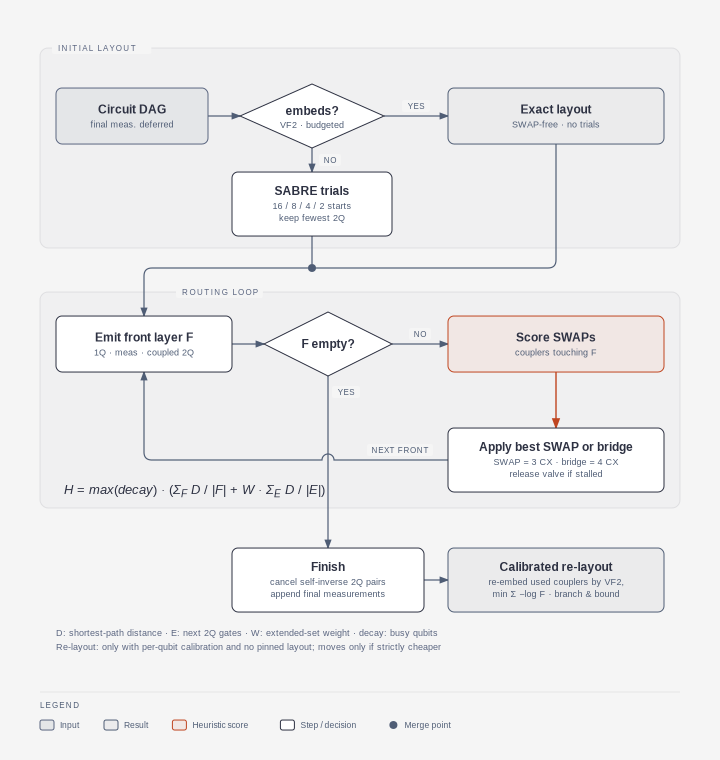
The heuristic scores every SWAP on a coupler touching the front layer F:
where \(D\) is the all-pairs shortest-path matrix. A release valve guarantees termination.
Exact layout first
Before SABRE, the router looks for a placement that needs no SWAPs at all: an embedding of the circuit's interaction graph (logical qubits joined by every two-qubit gate) into the coupling graph. The search is a VF2-style backtracking subgraph match. Logical qubits are placed breadth-first from the busiest one; every candidate must be coupled to the images of its placed neighbours and have enough free degree; roots are tried from the centre of the chip outwards. A GHZ chain, a star or a nearest-neighbour ansatz that fits the lattice is therefore routed with zero SWAPs (initial_layout_method: "exact"). If no embedding exists, or exact_layout_budget runs out, SABRE runs as usual.
Choosing among SABRE trials
Every trial (a compact BFS start plus seeded random starts, each refined by forward/backward passes) routes the whole circuit and runs cancellation. The trial whose emitted circuit has the fewest two-qubit gates (a SWAP counts as three CX) is kept. Scoring the real output, not an estimate, makes more trials monotonically better. layout_trial_two_qubit_gates reports every trial's cost.
Calibration-aware re-layout
SABRE minimises SWAPs; it does not know which qubits are good. After routing, the router therefore looks for a better placement of the routed circuit on the same chip, as Qiskit's VF2PostLayout pass does. It searches for every injective map of the used physical qubits onto other physical qubits that keeps each used coupler a coupler (a subgraph monomorphism), and scores each candidate with the twin's own calibration:
where \(F_{2q}\) is the fidelity of the device's entangling gate on that coupler, \(F_{1q}\) that of the first non-virtual one-qubit pulse on the qubit, and \(\bar\epsilon_{\text{ro}}\) the mean read-out error. The search is branch and bound with an admissible lower bound, up to noise_aware_budget steps. The circuit moves only to a strictly cheaper placement, so the SWAP count, the gate list and the ideal output are unchanged, and the cost never rises.
- It runs only when the twin has per-qubit or per-coupler calibration (IBM Heron, IBM Nighthawk and Google Willow snapshots). Twins with device medians only (IQM Emerald, Rigetti Ankaa-3, IonQ Forte, Quantinuum Helios) have nothing to choose between.
- An explicit or
trivialinitial layout is a request to use those qubits; it is respected. - The report adds
calibrated_relayout:applied,cost_before,cost_after,search_stepsandsearch_complete.
On the Heron snapshot, plain routing puts a 7-qubit GHZ state on qubit 46 (T₁ 8 µs, 8 % read-out error); the re-layout avoids it and raises the predicted GHZ fidelity by more than 0.05.
What routing preserves
- Semantics. The routed circuit's output state equals the source's state relabelled by the final layout, to 1e-9 including global phase. This is tested on random circuits, with and without bridges.
- Measurements and feed-forward. The dependency DAG spans qubit and classical-bit wires.
- Terminal measurements stay terminal. Final measurements are deferred and mapped through the final layout, so the fast sampling path and
return_statevectorstill apply. - Defective qubits in a calibrated map are avoided. Logical qubits are placed inside one connected component; if none is large enough, the job fails with
ResourceLimitError.
Bridges and cancellation
- Bridge:
CX(a,m) CX(m,b) CX(a,m) CX(m,b)executes CX(a, b) through a middle qubit m without changing the layout. It costs the same four CX as SWAP + CX. - Cancellation: after routing, identical self-inverse two-qubit gates (CX, CZ, …) cancel in pairs when everything between them commutes with them. Commutation is checked exactly on the joint unitary (≤ 4 qubits).
The routing report (compilation.routing)
| Field | Meaning |
|---|---|
swaps_inserted, bridges_inserted |
inserted SWAPs and bridges |
added_cx |
3 × (SWAPs + bridges) |
cancelled_two_qubit_gates |
gates removed by the cancellation pass |
input_two_qubit_gates, routed_two_qubit_gates |
before and after routing |
initial_layout, final_layout |
[logical, physical] pairs |
initial_layout_method |
exact, sabre, trivial or explicit |
layout_trial_swaps, layout_trial_two_qubit_gates |
SWAPs and routed two-qubit gates of each SABRE trial |
release_valve_activations, deferred_final_measurements |
diagnostics |
calibrated_relayout |
calibration-aware re-layout: applied, cost_before, cost_after, search_steps, search_complete (absent when it did not run) |
telemetry.breakdown.worker_route_ms measures the routing time.
Why there is no native SWAP or directed-coupler support
- SWAP cost is already minimal. A SWAP is lowered as three CX, i.e. three device entanglers. SWAP has KAK coordinates (π/4, π/4, π/4), so it needs three applications of any CZ-class entangler, iSWAP included.
- Couplers are genuinely symmetric. Every native entangler here (CZ, iSWAP, ZZMax/RZZ, MS) is symmetric in its two qubits, so a direction-aware router would have nothing to optimise.
Example: the cost of routing
for k in range(4, 15, 2):
    star = star_ghz(k)
    rejected = run("iqm_emerald", star)                            # 422
    routed = run("iqm_emerald", star, options={"routing": {"method": "sabre"}})
The routing benchmark shows the trade-off. At k = 16 the routed square lattices need 26–32 entanglers and Heron's heavy-hex lattice 42, against 15 on the all-to-all twins, and the predicted success drops to 0.44–0.87. With the default 16 trials, routing also costs 0.5–34.5 ms of router time per job; fewer trials cut that time at the price of extra SWAPs.